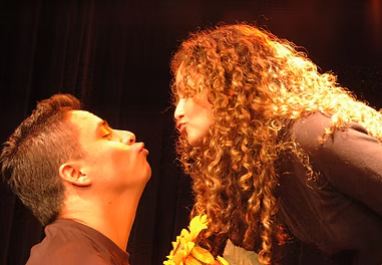
Like poetry, Lament is, more than a plot, a mixture of feelings evoked by images of great beauty and content, feelings that slyly seep in through the pores to move us deeply.
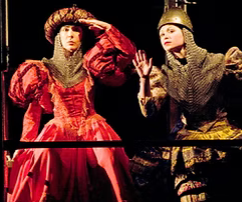
Crispín, the hero of the story, is a crafty servant who manipulates a group of people by way of invisible strings. He dupes the respectable citizens of a sixteenth-century city into believing that his impecunious master is a fabulously rich nobleman traveling incognito on a secret diplomatic mission.
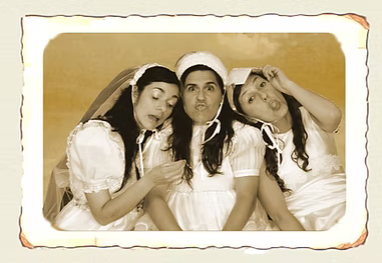
In the 1960s, on the eve of their First Communion, the triplets stay up through the night awaiting the happiest day of their lives. Twenty years later, on the eve of their joint wedding, the triplets replay their conversations, full of humor and not entirely devoid of clichés.
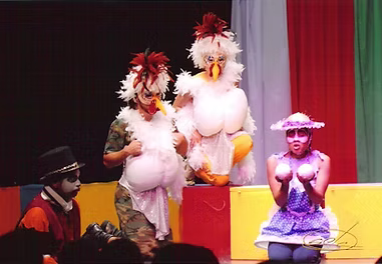
The story of a gluttonous mouse and other animals up to their usual tricks, and one in which minstrels interact with children. In the end, they all own up to their faults and promise to stop lying and blaming their friends. (In English and Spanish)
An interactive, educational and entertaining show full of magic, beauty and morals, presented through the magic of theatre. Each fable serves as a teaching tool of positive principles, where actors help kids discover them, with a beautiful original score and colorful and highly creative costumes. (In English and Spanish)
A frank and footloose clown invites the audience take an active part in the show, sharing the ridiculous and naive sides of human beings. On the menu there’s music, magic, juggling, group games and, of course, much humor. (In English and Spanish)
The Divine Philothea poses a battle, opposing forces, a dialectical, philosophical struggle between the soul, the world, the flesh and the devil. Here, soul, world and flesh are enemies, opponents. This approach enables us to engage in a live theatrical game, not subordinated to doctrine, that each audience member may evaluate in all its aspects. (In Spanish)
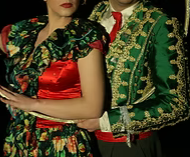
Two varieté artists, Paulino and Carmela, survive the maelstrom of the Civil War by putting on cabaret performances in the Spanish countryside. In a dialectic of the sublime and the ridiculous, a tragicomedy of deathly fear and fearless courage, the author offers an insight into this turbulent period of Spain’s history. (In Slovenian with Spanish supertitles)
A comedy about diversity, a difficult knot to unravel. At a fast pace, the actors discuss the play's tangled plot even as they act it out. The 12 characters operate the lighting, direct the musicians and move the action along. Nevertheless, the story's denouement will be up to the audience.
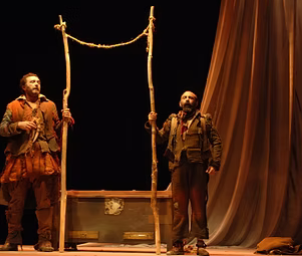
A story of two actors, their beginnings and their 20 years together, a history that we uncover over the course of a performance in which they face off and surrender so as to create new common space, new time.
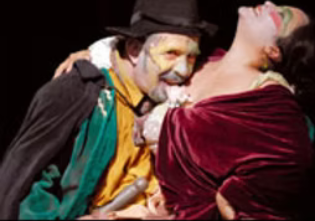
What truly grips us about La Celestina, who could be anyone, is the way in which old age pulls the strings of the age of innocence. At the end of the performance, we are left with a question. That uneasiness, which has lingered for more than five centuries, is the secret thread that connects us through time.